
Measuring Labor
Measuring Labor
In the Andes, precious objects like metals and minerals were long valued. Colonists looked for ways to efficiently take wealth and knowledge from the “New World,” creating methods to measure what they took. Gold, silver, cochineal, and cotton were extracted to enrich the crown, and later, to maximize personal profit. However, the laborers—Indigenous, creole, enslaved, and immigrant—did not often benefit. They too were measured and exploited.

Extracting Nature: Land, Labor, and Loss

The environment in the “New World” was diverse and unique, as those who already lived there knew well. This visual tribute list for Tenochtitlan, the Aztec capital, shows a variety of regional plants and animals. It illustrates how tribute—like feathers, textiles, cochineal—measured a subject region's loyalty and obligation.

Fast-forward a few centuries, and there was a new approach to the land. One of the most valuable agricultural products in the Americas was cotton. Huge areas of the US south had been transformed into cotton plantations, with the crop extracted by enslaved people. After abolition, making a profit from the plantations required new forms of exploitation, and immigrant labourers were used. These 1950s images show a Texas bracero using a cotton scale to weigh what he harvested, showing how workers’ value was measured by how much they picked—a practice that continues today.

These kinds of scales illustrate a new way of measuring both nature and labor. This steelyard scale could weigh up to 300 pounds of cotton, and the Texas cotton scale 160 pounds.

Crop harvesting continues to be hard work, often done in hot, tiring conditions. Field laborers, like those pictured picking strawberries, often use buckets to measure how much they have gathered, which can determine their wages. During the COVID-19 pandemic, in the strawberry fields of California, agricultural workers, such as those pictured here, were told to keep a safe "two pallet" distance from each other. Pallets, brooms, desks, benches, or cars became impromptu pandemic measures that reflected our different life circumstances.
Silver Stories: Reflections of Value in a Precious Metal
Today most of us are familiar with silver as a malleable metal for, say, jewelry yet these objects conceal a deeper history. The story of one particular place, Potosí in today’s Bolivia, guides us toward a tale of lost labor, exploited land, and redefined value.

Silver ore, by itself, is perhaps not particularly striking. This sample, from the ore deposits in Potosí, gives an example of the raw material.

For millennia, people have used ‘precious’ metals to make objects that they can treasure. Sometimes, these objects are made painstakingly and personally. For example, this Inca Tupu was a kind of pin used to fasten clothing. These were often shown in colonial descriptions and drawings of Andean women. Elegant tupus were worn by Indigenous elites to show their high social status.

This llama, though made of a different metal, also tells a story of personal and communal value. Llamas and their relatives were very important in the daily life of the pre-columbian Andes. Small figures like this one might have been made as ritual offerings.
These objects suggest one way of thinking about value.

Colonialism brought a different approach to understanding value. Seeing the land as a resource to be exploited enabled mass profit. The more silver ore that could be extracted, the better. After the discovery of silver deposits in the 1540s, the mine at Potosí turned ore like the sample above into one of the largest profit-making sites on Earth.
Profit for whom? A vast amount of labor was required, but those who labored most would not share in the profits, or even in the recognition. In this depiction of Potosí, the workers – human and animal, Indigenous and enslaved – were made anonymous. The landscape was transformed technologically in order to be exploited in service of foreign profit. Note the Christian cross on the summit of the Cerro Garda de Potosí, the Spanish name of the mountain in the background.

The extracted Potosí silver was taken to Europe, where silversmiths increased its value by crafting it into expensive objects for the wealthy, far removed from the forced labor in the mines. Here, the silver was reshaped to hold another precious item often extracted from American land by enslaved laborers: sugar.
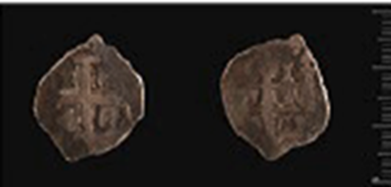
Some of the silver, of course, was melted into coins, stamped with Spanish royal markings, and given a monetary value, representing control over land and labor. The overlapping ‘P’ and ‘S’ symbol show that the silver for this coin came from Potosí.
Further Reading
General Audience Resources
American Archive of Public Broadcasting. “Stories of the Land: Diverse Agricultural Histories in the U.S.,” https://americanarchive.org/exhibits/stories-of-the-land/3-work.
California Public Library. Online Exhibit: The Skaar Collection of artifacts related to Chinese immigrants who made their homes in and around Grass Valley, California. https://artsandculture.google.com/story/8QXxCa4KRzlNKA.
- Escobar, Mel. “Braceros Across the United States - Mexico Border,” Latinos in Heritage Conservation, May 4, 2023, https://storymaps.arcgis.com/stories/4a2e09dcc5474a12a34993ec8eb06620.
Academic Readings
Bakewell, Peter John. Miners of the Red Mountain: Indian labor in Potosí, 1545-1650. Albuquerque: University of New Mexico Press, 1984.
Barragán, Rossana, and Paula C. Zagalsky, eds. Potosí in the Global Silver Age (16th—19th Centuries). Leiden, The Netherlands: Brill, 2023, https://doi.org/10.1163/9789004528680.
Lane, Kris. Potosí: The Silver City That Changed the World. Oakland: University of California Press, 2019.
- Rutledge, Ian, Colin Harding, and Kenneth Duncan. Land and Labour in Latin America : Essays on the Development of Agrarian Capitalism in the Nineteenth and Twentieth Centuries. Cambridge ; New York: Cambridge University Press, 1977.