
Clone of Measuring Humans
Measuring Humans
What happens when humans are measured and don’t fit the “normal” standard? As we measured space, nature, and labor, people also measured each other— their thoughts, appearances, and potential, often using the human body as a guide. “Standardized” psychological tests and color charts were used to organize and categorize people’s minds and bodies.

Reimagining Casta Paintings with Nancy Friedemann-Sánchez
In the 18th century, Spanish elites in colonial Mexico used paintings to classify people based on their racial background and appearance. This socially constructed system was called the ‘casta’ system. In this painting, the 16 rectangles in a grid represent an almost mathematical formula for the mixing of different racial “types,” moving from left to right: a+b=c, c+d=e, and so on. The final row includes such derogatory terms as “tente en el aire” (“hold yourself in the air”) and “no te entiendo” (“I don’t understand you”), showing how the project of rigid racial mathematics breaks down even on its own terms as people defied categorization.
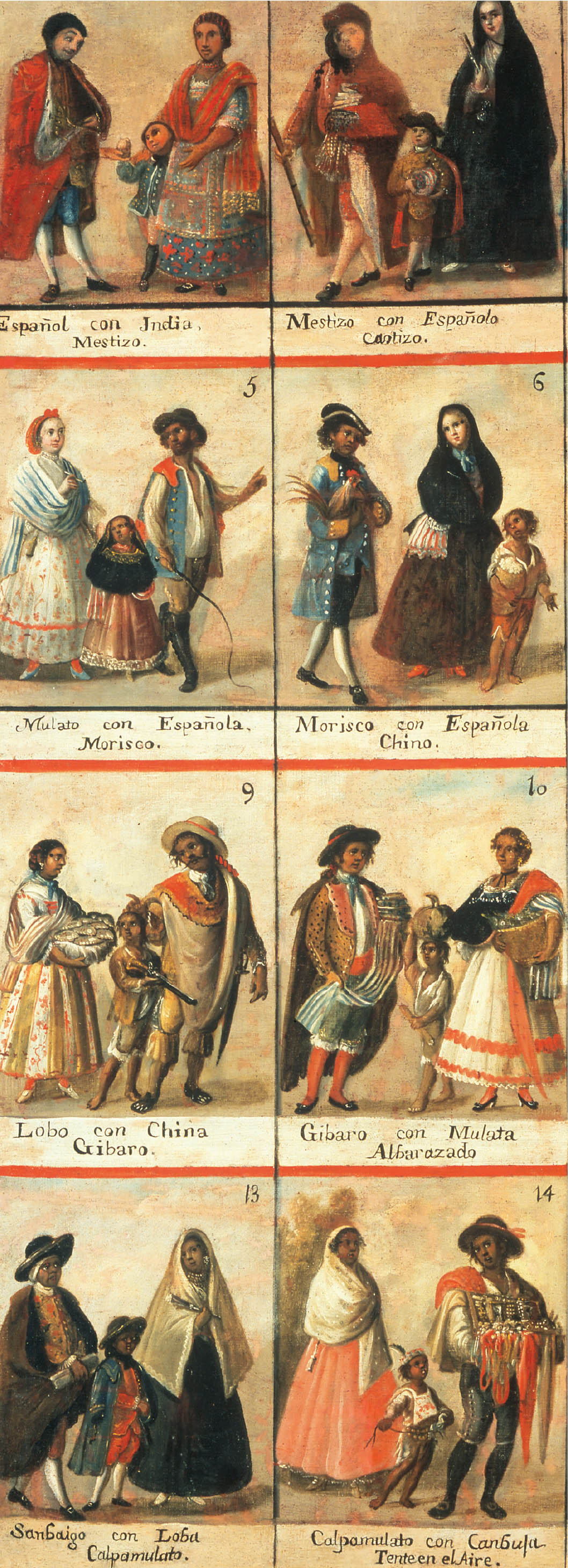
Table of 'Castas'. Instituto Nacional de Antropología e Historia, Mexico. Reproduced via CC BY-NC-ND 4.0 License
Loba Garifuna
Loba Garifuna is a reimagining of the 18th century Casta paintings for a contemporary world where some bodies are still perceived as threats. Artist Nancy Friedemann-Sánchez traces the bodies of Latina women in the TSA search pose, using ink “to create a ‘stained’ aesthetic—a reference to colonial justifications of genocide” based on skin color. The animal mask speaks to the racist belief that miscegenation led to a degeneration of the human species. The peineta, a Spanish comb, alludes to the imperial origins of racial categories in Latin America.
Born in Colombia to an American father and Colombian mother, Friedemann-Sanchez straddled cultures and languages from her youth. Like thousands before her, Friedemann-Sánchez fled the violence caused by the rise of the Medellín drug cartel and settled in New York, before moving to the Midwest. Her art challenges us to imagine the exchange and clash of different worlds, and how people entering and leaving these words are viewed and surveyed.
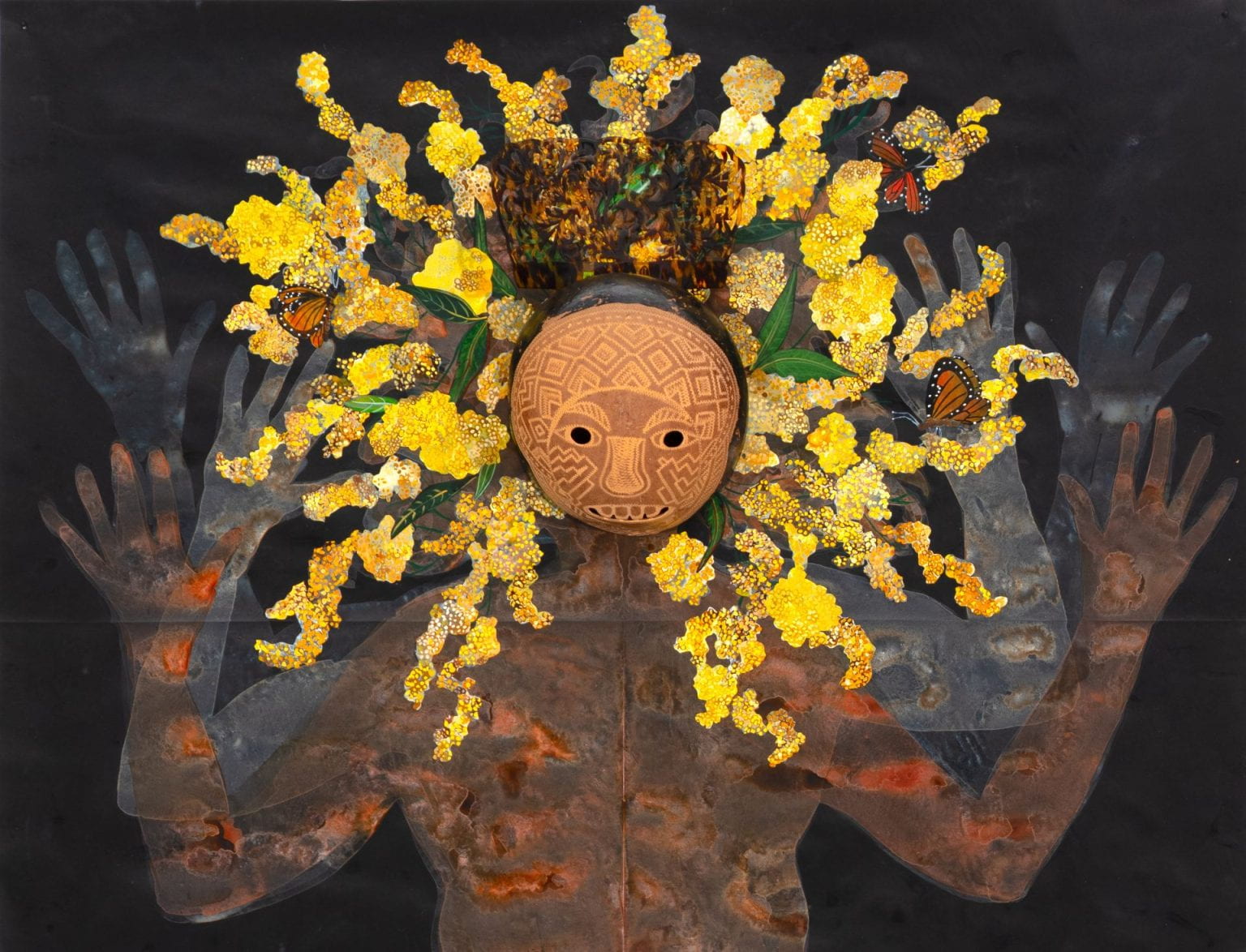
Loba Garifuna. Friedemann-Sánchez, Nancy. 2024, 80″ x 40″, Ink on Tyvek and found objects, Courtesy of Instituto de Vision, New York/Bogotá. Photo credit: Larry Gawel.
Seeing Difference: from the Aztec Body to Norma Normal
According to ancient Mesoamerican beliefs, the body was used to organize and measure the world, connecting different body parts to thoughts and forces. This image links body parts to the twenty-day ritual calendar.
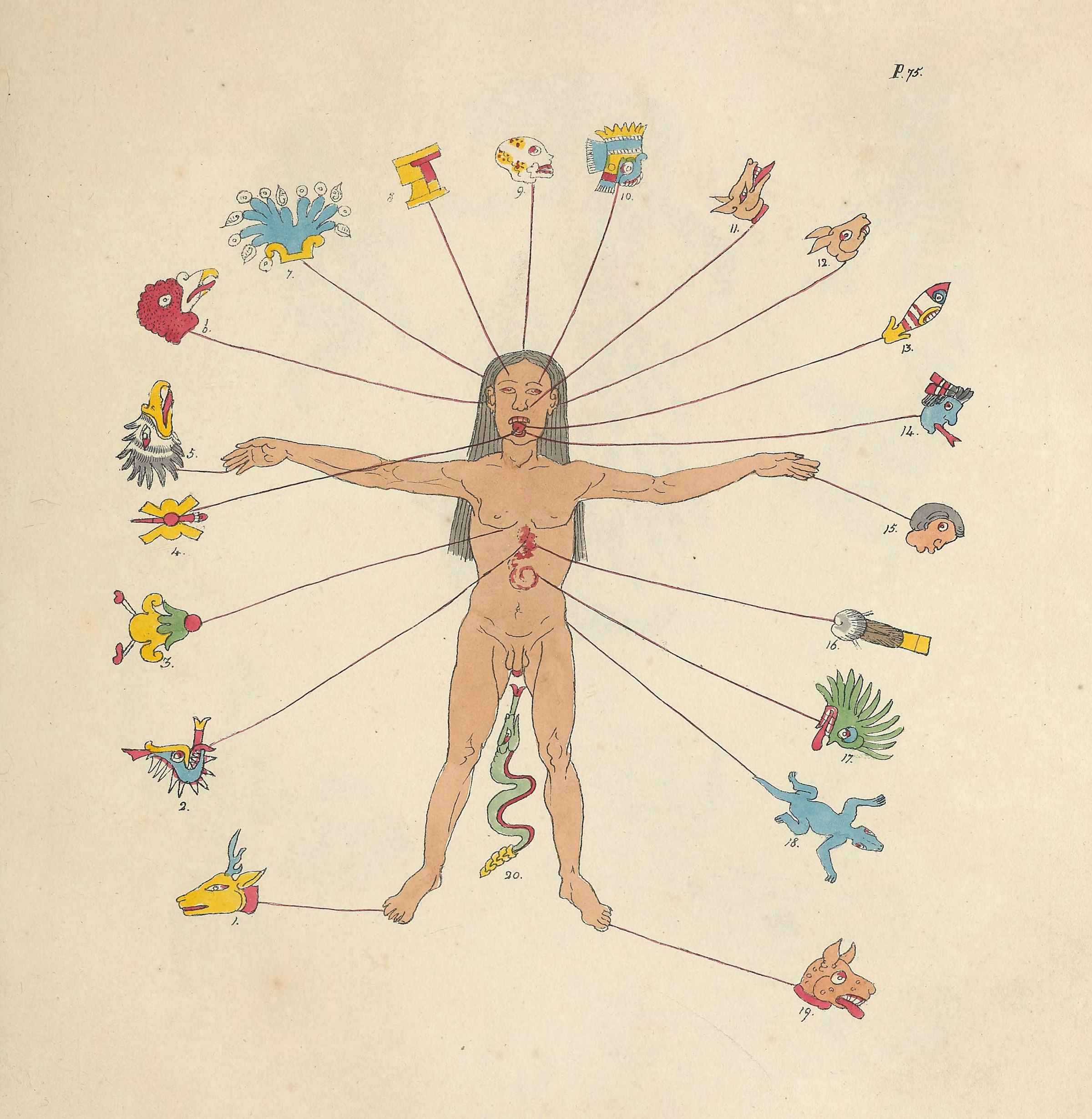
Nahua Depiction of The Body, from Antiquities of Mexico, reproduced 1831-1848. • Image Courtesy of the Tozzer Library, Special Collections, Harvard University.
Some measures reduced human beings to the appearance of their skin, creating numerical gradients of color to which individuals could be compared. These were tools of 20th century physical anthropology, often used alongside measurements of other body parts—including craniometry, the measurment of skulls—to create definitions of race. What do charts like this one fail to show? What type of thinking do they enforce?
Medical devices created metrics to describe the body—including by encasing the body, as in this machine, a body plethysmograph from around 1960 used to measure lung capacity. A person would sit inside the box with their head in the glass dome on top and breathe into the tube at the front of the dome.
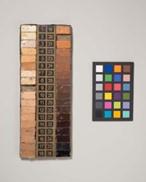
Skin Color Chart, c. early 20th century. #2005.1.171. On Loan from the Peabody Museum of Archaeology and Ethnology, Harvard University.
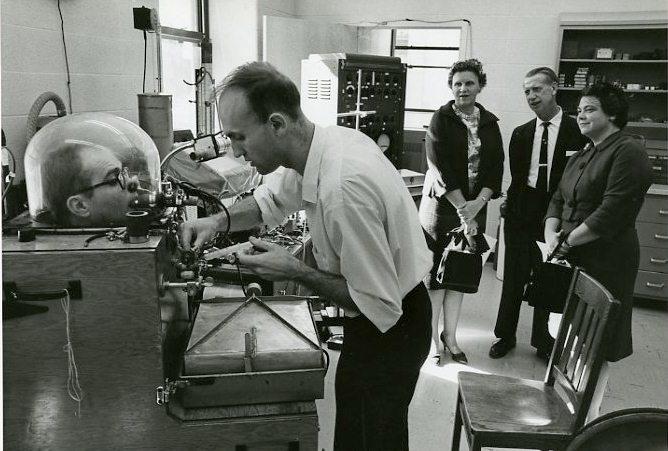
“Body Box" Plethysmograph, c. 1960. Courtesy of the Warren Anatomical Museum and the Archives of the Harvard T.H. Chan School of Public Health, Department of Environmental Health.
How do you measure up to Norma?
What does a ‘normal’ person look like? In 1943, one obstetrician thought he had the answer. He created diagrams of “Norma” (and her male counterpart, “Normman”) based on the measurements of 15,000 white men and women. Linked to the eugenics movement, these diagrams showed the “average American woman” and were used as a standard to measure, profile, and judge other people.
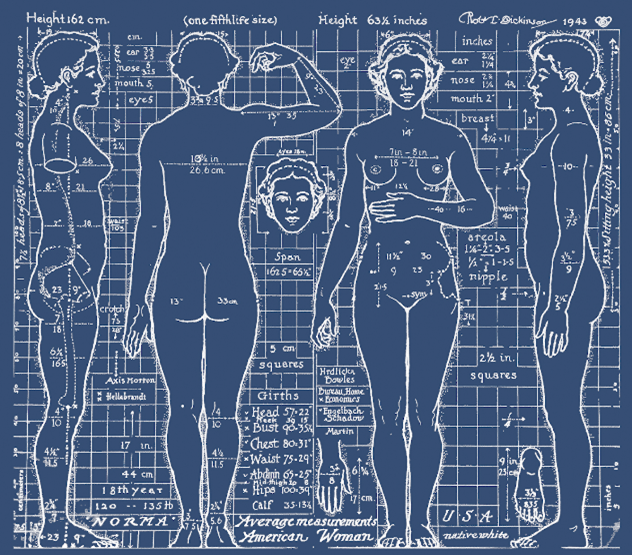
Is Norma normal? Robert Latou Dickinson & Abram Belskie, 1943.
Further Reading
General Audience Resources
“Pride and Anxiety in New Spain: Francisco Clapera, Set of Sixteen Casta Paintings, c. 1775,” Smarthistory, January 9, 2018, https://youtu.be/Opdr_qnGPcw?si=9u39Ix_14iRtUNC5.
Rich, Nathaniel. “Can Humans Endure the Psychological Torment of Mars?” New York Times, February 25, 2024, https://www.nytimes.com/2024/02/25/magazine/mars-isolation-experiment.html.
Academic Readings
Carter, Julian B. The Heart of Whiteness: Normal Sexuality and Race in America, 1880–1940. Durham: Duke University Press, 2007.
Hogarth, Rana A. Medicalizing Blackness : Making Racial Difference in the Atlantic World, 1780-1840. Chapel Hill: University of North Carolina Press, 2017.
Martínez, María Elena. Genealogical Fictions: Limpieza de Sangre, Religion, and Gender in Colonial Mexico. Stanford: Stanford University Press, 2008.
Poskett, James. Materials of the Mind : Phrenology, Race, and the Global History of Science, 1815-1920. Chicago: University of Chicago Press, 2019.
- Rosenthal, Caitlin. Accounting for Slavery : Masters and Management. Cambridge, Massachusetts: Harvard University Press, 2018.