# Measuring Nature
## Measuring Nature
European expeditions to the Americas during the 18th and 19th centuries sought to understand the New World by measuring and cataloging it. The objects in this section measured everything from mountains to animals, from color to humidity. These were assembled to create “the natural world,” something distinct from the human world and thus ripe for exploitation and extraction. Later, private institutions, including Harvard, played a part in measuring the natural world of the Americas through scientific expeditions.

## Explore this section
[ Maps and Dyes arrow\_circle\_right ](https://measuringdifference.hsites.harvard.edu/node/1903111/#maps) [ Harvard’s Thayer Expedition to Brazil: Jars of Fish and Coffee arrow\_circle\_right ](https://measuringdifference.hsites.harvard.edu/nature#thayer) [ Plants and Pigments arrow\_circle\_right ](https://measuringdifference.hsites.harvard.edu/nature#plants)
#### Maps and Dyes
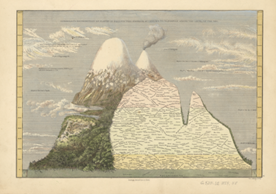
*Humboldt’s Scientific Representation of the Chimborazo Volcano In Ecuador, 1854. Image Courtesy of the Harvard Map Collection, Harvard University. #G5201.D2 1854* This elevation map of the Chimborazo volcano shows where different plants grow at different heights. Alexander von Humboldt linked altitude with latitude, introducing both the burgeoning field of biogeography and a new way of understanding the mountain—which locals had revered as a deity before the arrival of Europeans.
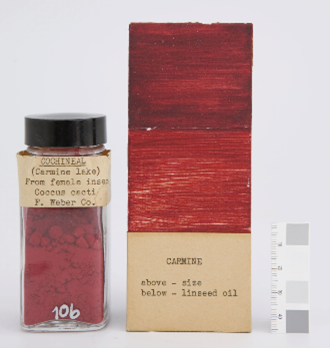
*Cochineal Dye, 1941. On Loan from the Harvard Art Museums/Straus Center for Conservation and Technical Studies, Forbes Pigment Collection. #Straus.106 Harvard University*The story of cochineal dye links together the extraction, commodification, and depiction of New World plants and animals. The pigment is harvested from scale insects that live on the prickly pear cactus, a plant whose medicinal uses are documented in the 16th century Latin-Nahuatl manuscript known as the Codex Badiano. By the turn of the 19th century, European naturalists were using cochineal pigments to paint and classify the flora of Mexico on scientific expeditions.
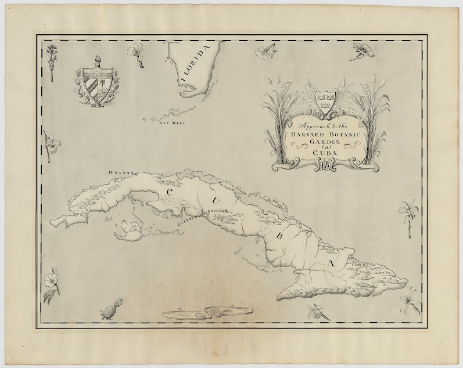
*Approach to the Harvard Botanic Garden in Cuba, by Blanche Ames, 1903. Image Courtesy of the Archives of the Economic Botany Herbarium of Oakes Ames, Harvard University*From 1901 to 1961, Harvard operated a botanical garden in Cuba on a former sugarcane plantation. As a tropical research station, the botanic garden exchanged plants with the notorious United Fruit Company in Honduras. This map, which shows the entire island of Cuba with tropical plants sketched along the border, was made by Blanche Ames. Blanche’s husband Oakes Ames was a Harvard economic botany professor who helped direct the garden’s research efforts. Though never a professor herself, Blanche made many teaching materials and botanical illustrations.
#### Harvard’s Thayer Expedition to Brazil: Jars of Fish and Coffee
Louis Agassiz, founder of Harvard’s Museum of Comparative Zoology, and his wife, Elizabeth, went on a research expedition to Brazil in 1865, sponsored by Nathaniel Thayer. While Agassiz primarily planned to study fish, he also commissioned hundreds of objectifying portraits of African and Indigenous Brazilians to support his ideas about racial types. These photographs were taken by Walter Hunnewell and are held at the Peabody Museum of Archaeology and Ethnology today. Both activities—collecting specimens and photographing people—were part of Agassiz’s mission to measure differences between animal species and human races.
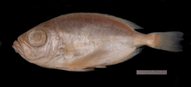
*Priacanthus arenatus: Specimen Collected by Louis Agassiz. MCZ Ichthyology #9772. Harvard Museum of Comparative Zoology.*This is a specimen of Priacanthus arenatus collected by Agassiz in Brazil in 1865. Though imaged here against a black backdrop, it is stored in preserving fluid in a glass jar—what is called a “wet” specimen.
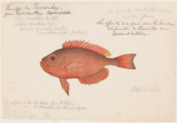
*Watercolor Drawing by Jacques Burkhardt, Rio De Janeiro, Brazil, 8 June 1865. Image Courtesy of the Ernst Mayr Library, Special Collections.*To show how this and other fish looked in life, Agassiz hired the artist Jacques Burkhardt to join his expedition. Burkhardt made nearly 2,000 paintings, which were crucial for scientific study. As in this case, the paintings often featured annotations to identify the painting’s subject and record the date and place it was painted. The paintings captured visual details that the preserved specimens could not. To fully understand and document a species, a single representation was not enough. Compare the specimen to the painting: what differences do you see?
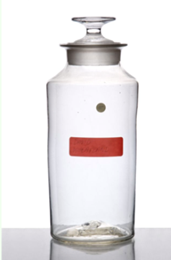
*Collecting Jar Belonging To Agassiz Expedition, c. 1864-1866. CHSI #1997-1-1570*This clear glass jar was used to collect specimens on Agassiz’s expedition. Although it seems simple, jars like this were also scientific instruments. They were used to hold, transport, and display parts of nature, turning them into measurable items for study.
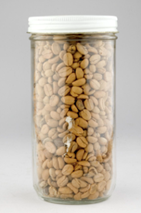
*Collecting Jar of Coffee Beans, 1865. CHSI #1997-1-1905.*The glass jars did not only contain animal specimens. In the memoir [*A Journey in Brazil*](https://www.biodiversitylibrary.org/bibliography/1787) (1868), Elizabeth Agassiz described their visit to *fazendas* or coffee plantations, where no doubt these beans were collected. Slavery was not abolished in Brazil until 1888, and the coffee beans preserved in this jar as scientific specimens would have been grown and harvested by enslaved people. Coffee accounted for about half of Brazil’s exports in the 1860s, and studies to improve the crop and tackle pests formed the discipline of economic botany.
#### Plants and Pigments
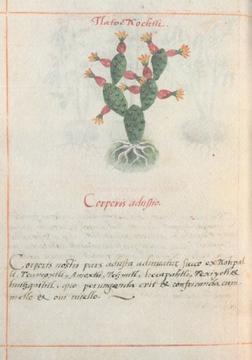
*Codex Badiano. Image courtesy of Instituto Nacional de Antropología e Historia, México (CC-BY-NC-ND)*This *Codex Badiano*, an herbal manuscript from 1552, includes illustrations and details of Nahua medicinal plants. Written in both Nahuatl and Latin, it shows how Indigenous knowledge was translated into European ways of organizing and understanding the world. This particular page shows a prickly pear cactus, of genus Opuntia, with its Nahuatl name tlatocnochtli written above the plant. This cactus is the host plant of the parasitic scale insect *Dactylopius coccus*.

*Cochineal Dye, 1941. On Loan from the Harvard Art Museums/Straus Center for Conservation and Technical Studies, Forbes Pigment Collection. #Straus.106 Harvard University*The *Dactylopius coccus* insect naturally produces carminic acid, which is extracted to produce cochineal dye. Produced in colonial Mexico for export, the dye was prized by merchants, artists, and dyers as the “perfect red”. Beyond Mexico, commercial producers used cochineal extract, along with binding agents like linseed oil, to create red pigments such as carmine lake, shown in this paint samplel. For more on cochineal, see the [Harvard Museums of Science and Culture’s online exhibit](https://hmsc.harvard.edu/online-exhibits/cochineal/), “How Mexico Made the World See Red.”
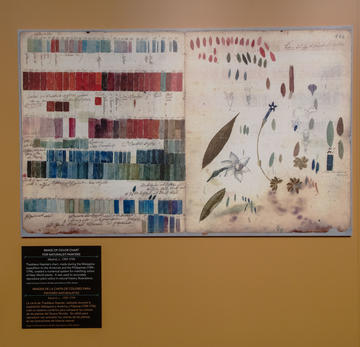
*Image Of Color Chart For Naturalist-Painters, Madrid, c. 1789–1794, by Thaddeus Haenke. Original image courtesy of Archivo del Real Jardín Botánico (CSIC), Madrid. Photograph by Frank Graham.*Thaddeus Haenke’s chart, made during the Malaspina expedition to the Americas and the Philippines (1789-1794), created a numerical system for matching colors of New World plants. It was essentially a “paint by numbers” method to record numerical color observations in the field that could later be filled in with the respective pigment, thereby accurately reproducing plant colors in natural history illustrations. Cochineal is the basis for several of the carmine red pigments on the second row of this color chart—the dried extract of a New World insect used to classify American plants.
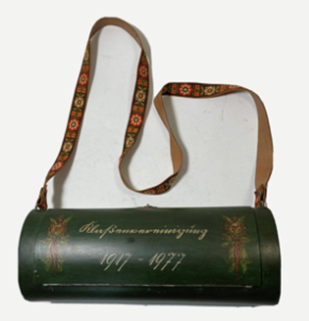
*Vasculum For Botanical Specimens. Harvard University Herbaria*Natural history illustrations were accompanied by another form of capturing nature: dried plant specimens. But how could these be safely transported? This vasculum was used to preserve botanical specimens collected in the field, before they could be pressed, dried, and mounted on herbarium sheets. Identifying plant species often required precise measurements of size, color, and other physical attributes.
#### Continue
[ Continue to Measuring Labor arrow\_circle\_right ](https://measuringdifference.hsites.harvard.edu/labor)
#### Further Reading
General Audience Resources
- Iqbal, Saima S.. ”Louis Agassiz, Under a Microscope,” *The Harvard Crimson*, March 18, 2021. .
- Soto Laveaga, Gabriela and Harvard Museums of Science and Culture. “Cochineal,” HMSC Online Exhibit. .
Academic Readings
- Bleichmar, Daniela. *Visible Empire: Botanical Expeditions & Visual Culture in the Hispanic Enlightenment*. Chicago: University of Chicago Press, 2012.
- Fernandez-Prieto, Leida. “Networks of American Experts in the Caribbean: The Harvard Botanic Station in Cuba (1898–1930).” In *Technology and Globalisation*, edited by David Pretel and Lino Camprubís, 159–187. Palgrave Macmillan, 2018. [https://doi.org/10.1007/978-3-319-75450-5\_7](https://doi.org/10.1007/978-3-319-75450-5_7).
- Gimmel, Millie. “Reading Medicine in the Codex de La Cruz Badiano.” *Journal of the History of Ideas* 69, no. 2 (2008): 169–92, .
- Montero Sobrevilla, Iris. “The Disguise of the Hummingbird: On the Natural History of Huitzilopochtli in the Florentine Codex.” *Ethnohistory* 67, no. 3 (July 1, 2020): 429–53.[ https://doi.org/10.1215/00141801-8266434](https://doi.org/10.1215/00141801-8266434).
- Thurner, Mark and Jorge Cañizares-Esguerra, eds. *The Invention of Humboldt: On the Geopolitics of Knowledge*. London: Routledge, 2023.